
Hi y’all!
Welcome again to new subscribers. Last week was an intense week. For different reasons. It was nice to have Wijkbot at this event and join a robots-in-Rotterdam event. And I managed to watch 6 movies in a day at IFFR (check my ratings at Letterboxd).
In other news, the first reviews of the Vision Pro arrived as the device was delivered to buyers in the US. I have some thoughts to share below.
Triggered Thoughts
So, the first batch of Vision Pro goggles is delivered to the happy few US tech reviewers and Apple fans. Hands-on experiences are shared all over the internet, including a set of memes of people wearing them on the street. You can check several reviews. MKBHD and Casey Neistat, The Verge, Wired, and John Gruber, to name a few. All were rather positive about the potential and the quality of the experience, with some small critiques on weight and some functions. Ian Bogost is classified as spectacular and sad at the same time. Paris Marx (Tech Won’t Save Us) has a more critical review, wondering what is the vision for the category as a whole. That makes sense for a part; the category of AR and VR is not making our ubiquitous digital life more social and connected as some claim; it intends to make even more of our real-life digital.
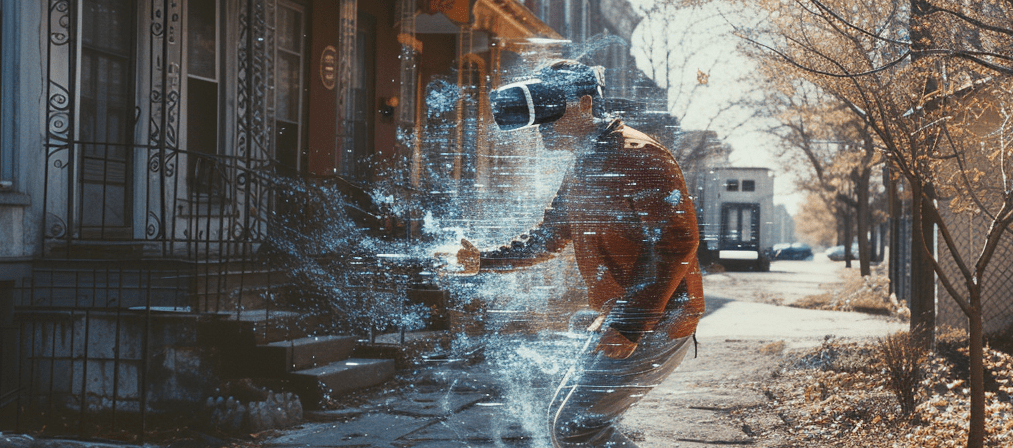
That said and acknowledged, I like to zoom out a bit on one aspect, a characteristic that the Vision Pro seems to be mastering: the passthrough fake reality you start to live in. This is made so well that it feels rather real and makes it possible to experience an augmented reality closer than expected. That is about ultra-low latency and screen quality in a technical sense, and that makes it possible for Apple to put augmented reality as a primary experience. But not as a Google glass or AR glasses concepts where the reality literally got a projected layer, but as a virtual world that mixes in reality as reality. It is a super interesting approach that already, after a couple of days of use, seems to be working. People accept these goggles much better in public spaces than other devices.
Benedict Evans had a sharp analysis right after the announcement in June: “For Meta, the device places you in ‘the metaverse’ and there could be many experiences within that. For Apple, this device itself doesn’t take you anywhere – it’s a screen and there could be five different ‘metaverse’ apps.”
The passthrough is becoming a reality setting. It is a kind of bent real, though, mutilated in a sense. What happens when this is normalised more and more? We are kind of used to computational pictures. Some types of situations deliver better representations of reality through the computed picture than the live view. What if this becomes the continuum? It will create a kind of Brave New World, we don’t know what is real or not, and that opens also potential misuses. What if the predictive world is taken over the real version, will the real follow that predictions?
I am not opposing the development here, but curious to follow with this lens. We have time, but we will be stimulated to prepare for the future. You can already start capturing life events with your current iPhone 15 pro for future use in the next generations of cheaper versions.
Repeating danger of pass-through is the potential of interfering (and infering) without noticing. I still trust Apple for good intentions, but are the unintended consequences covered?
Kevin Kelly speaking of a trustfilp: “The arrival of generative AI has flipped the polarity of truthfulness back to what it was in old times. Now, when we see a photograph, we assume it is fake, unless proven otherwise.” That might be a good thing, being critical, or are we losing the reference of the real?
Read the events of the week, notions from the news and paper for the week in the newsletter.
See y’all next week!
A week ahead with writing papers and proposals and updating my ‘digital presence’, it is starting to feel overdue…
Have a great week!

 target is new