

Hi, y’all!
Never a dull summer! It is troubling seeing big techies connecting to Trump; it is opportunistic and in line with a kind of backlash against regulators. And the vulnerability of the networks and interdependencies showed with the CloudStrike
Here in the Netherlands, the last batch of vacation slots started, so the weeks become more quiet with meetings and events especially. Last week, I was engaged in a scientific conference, EASST-4s, and visited a couple of panels next to the one we were part of with Wijkbot. It was a nice atmosphere (and a pleasant Brutalist building), with more than 4000 attendees and numerous sessions, which were too many to digest. Below, I will reflect a bit on the Transformation in agency (in the age of machine intelligence)-panel.
As mentioned, we presented the case of the Wijkbot in a panel on the Kit Economy, a newly coined concept that turned out to be more connected to the maker’s feelings than the description initially suggested. I think there are still open questions on the economy part.
In this diagram, the first ideas on the Kit are illustrated: a kit always consists of parts, tools, and documentation. The role of using kits as a learning instrument, or as a kind of action product. The producer and user merge in a “prod-user,” more than a prosumer, producer, and consumer, which is more passive. As referred to: “it brings us back to the classic STS issues of the joint development of objects and their technical and social environments (Akrich 1989).”
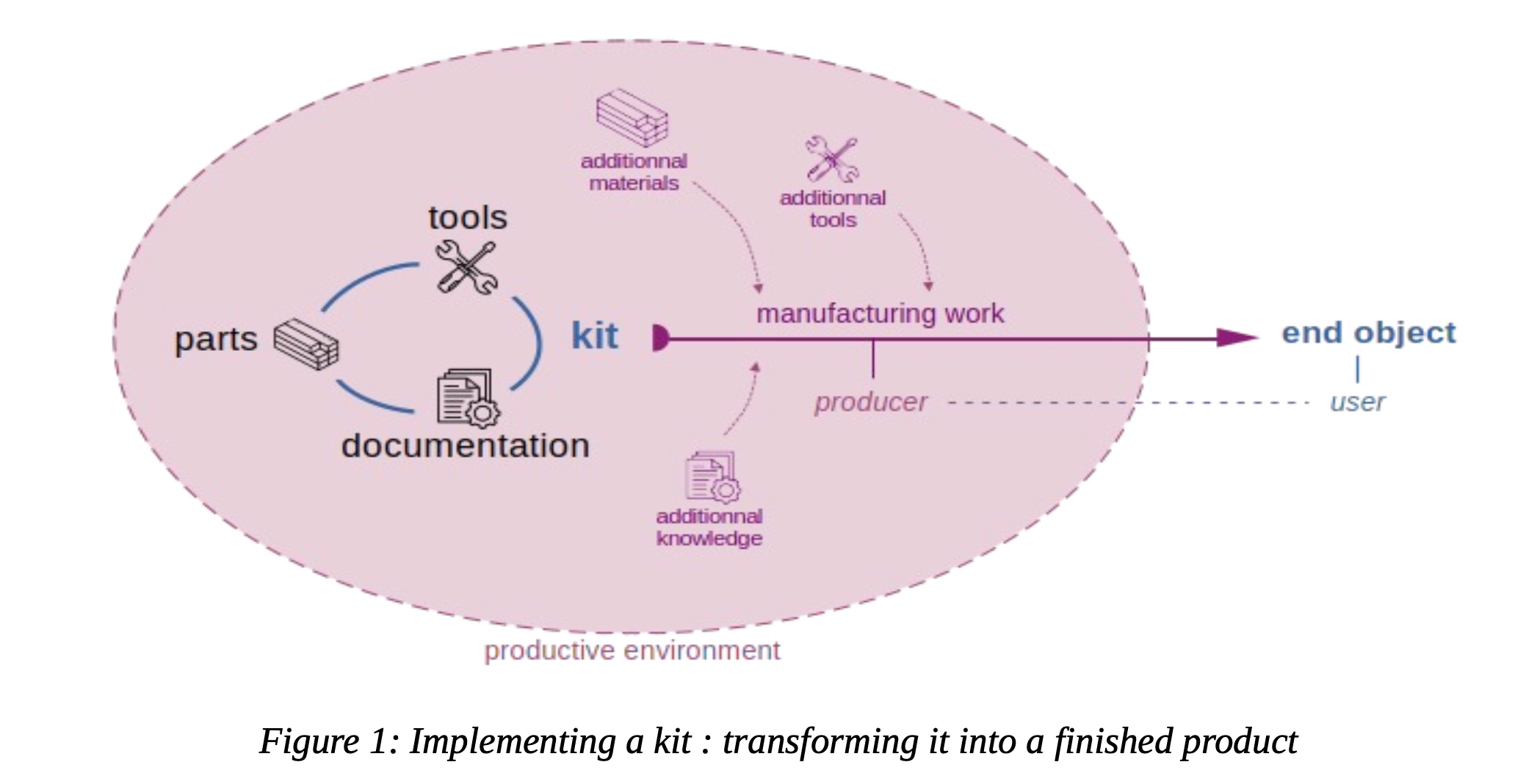
Kits were discussed with different types of examples. A meal kit is not a kit as it does not provide tools. Is a kit always meant to reach a defined end state like the IKEA kits? That differs, of course, from the WijkbotKit, where the outcome is undefined, and the kit is a means to an end, gaining insights for the future.
So is a kit part of a business model (IKEA), or marketing strategy to engage more with the brand (IKEA again). The examples of real open source and collaborative working with the example of the Vheliotech.
So to conclude; as expected the panel is opening up new questions. On the impact of the context on what a kit actually is. And how it relates to economic principles. Nice to be part of the panel.
Triggered thought
As triggered thought I like to refer to another session I followed at the conference: Transformation in agency (in the age of machine intelligence)-panel.
In this session, there were two parts with about 8 presentations, half more fundamental and conceptual and the others more applied. How worlding and world models are shaping agency. And the presentation Markus Burkhardt (University of Siegen) dived deeper in What is in an AI agent.
Some literature; An agent is something that acts, makes sense. And is a rational agent if it act to achieve the best outcome (Russel and Norvig, 2022). Criteria on intelligent agents according to Wooldridge (2002): reactivity, proactivity, sociality. Already in 1996 different agent typologies are proposed by Nwana, see this graph.
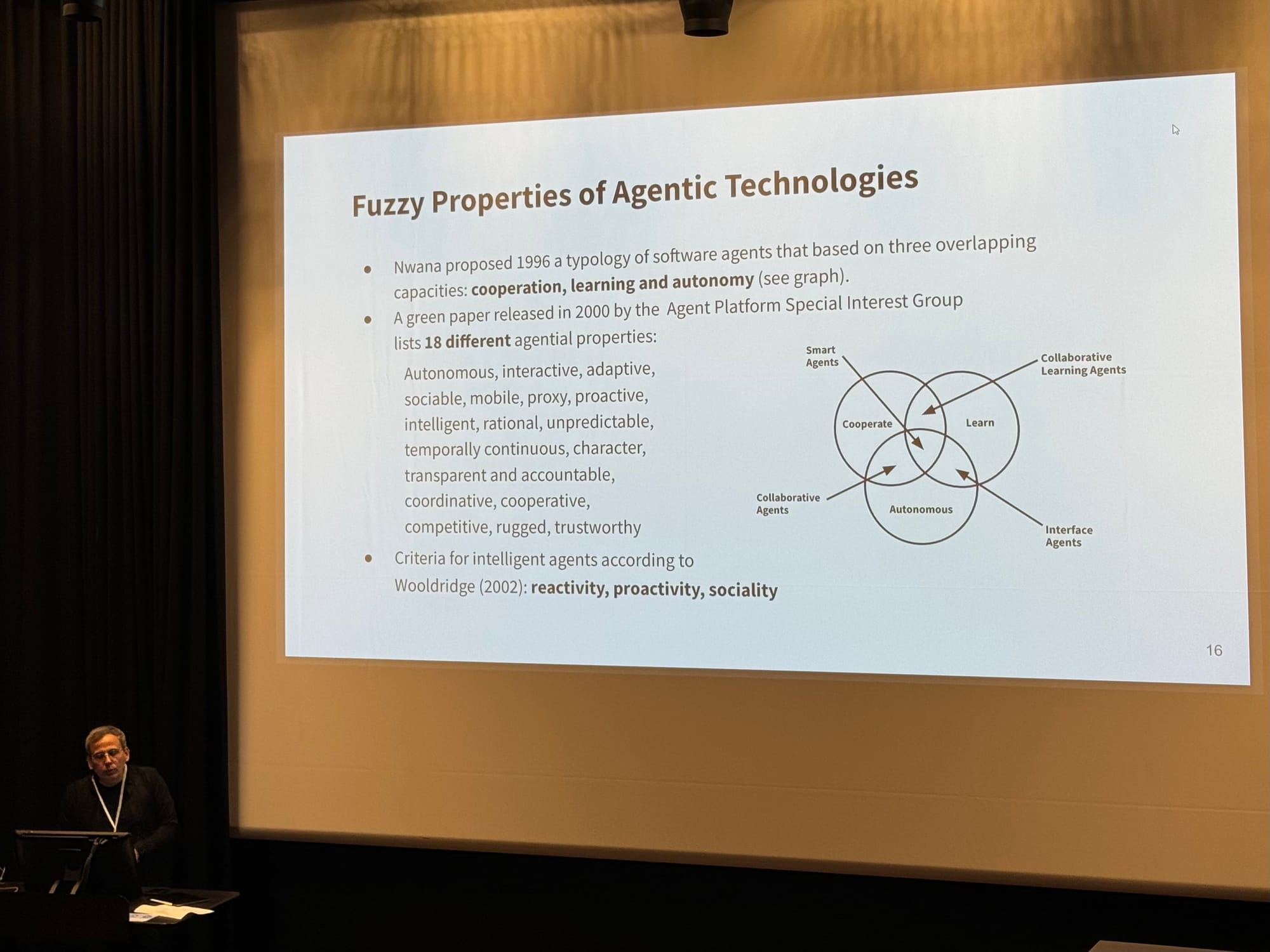
In the current times of LLMs agenticness of AI is defined by a degree, in goal complexity, environmental complexity, adaptability, independent execution.
He built a case around the difference between ChatGPT and GPTs. Even within AI, the level of agenticness is still in development. He created a practical guide on prompting, but what I find more interesting is the question of whether we will get synthetic agency and how we relate to this.
Later, Eitan Wilf’s presentation on AI and music creations gave an interesting example of an agentic piano. The concept of the continuator is continuing the human’s playing. It is not inspiring or inventing anything new. Therefore, it is necessary to mix different styles, not missing out on the conversation between the human and the machine.
Circle back to the model of the kits. What if this is mixed with the agenticness? What if the kit has agency? What if the exchange of producer and user participating in an agentic process becomes a symbiotic exchange of producing and using? Is the kit more a boosting of the learning and engaging experience or breaking down the necessary agency of the user? With the kit model, the producer is opening up its intentions and creating options for adapting user agency.
Read the full newsletter here, with
- Notions from last week’s news on Human-AI partnerships, Robotic performances, Immersive connectedness, and Tech societies
- Paper for the week
- Looking forward with events to visit
Thanks for reading. I started blogging ideas and observations back in 2005 via Targetisnew.com. Since 2015, I have started a weekly update with links to the news and reflections. I always capture news on tech and societal impact from my perspective and interest. In the last few years, it has focused on the relationship between humans and tech, particularly AI, IoT, and robotics.
The notions from the news are distributed via the weekly newsletter, archived online here. Every week, I reflect more on one topic, a triggered thought.
I share that thought here and redirect it to my newsletter for an overview of news, events, and more.
If you are wondering who is writing, I am Iskander Smit. I am an industrial design engineer educated in digital technology and have worked in digital technology all my life. I am particularly interested in digital-physical interactions and a focus on human-tech intelligence co-performance. I like to (critically) explore the near future in the context of cities of things. And organising ThingsCon. I call Target_is_New my practice for making sense of unpredictable futures in human-AI partnerships. That is the lens I use to capture interesting news and share a paper every week.
Feel invited to reach out if you need some reflections; I might be able to help out!

 target is new